

When people think about building a new park, school, road, downtown district, or sports complex, they often assume the project starts with engineering.
In reality, the first question usually isn't "How do we build it?"
It's "What should we build—and why?"
That's where planning comes in.
While planning and engineering are closely connected, they serve very different purposes. Understanding the difference helps communities make smarter investments, avoid costly mistakes, and create projects that will continue serving people for decades.
At JPR, we provide both planning and engineering services—along with many others. That means we don't just help clients imagine what's possible, we help make it a reality.
Planning focuses on the big picture.
Before design begins, planners work to understand the community's needs, goals, challenges, and opportunities. They gather public input, analyze existing conditions, study future growth, and develop strategies that guide long-term decision-making.
Think of planning as creating a roadmap before starting the journey.
Planning can answer questions such as:
The end result is often a master plan, comprehensive plan, transportation study, downtown plan, or parks master plan that provides a clear direction for future investment.
Engineers determine exactly how a project will be built, translating ideas and concepts into practical, constructible solutions.
Their work can include roads and intersections, water and wastewater systems, stormwater management, bridges, utilities, and site development. Engineers consider how these systems work both individually and together to create infrastructure that allows communities to function safely, efficiently, and reliably.
Engineering answers questions like:
Planning and engineering aren't separate processes—they're partners.
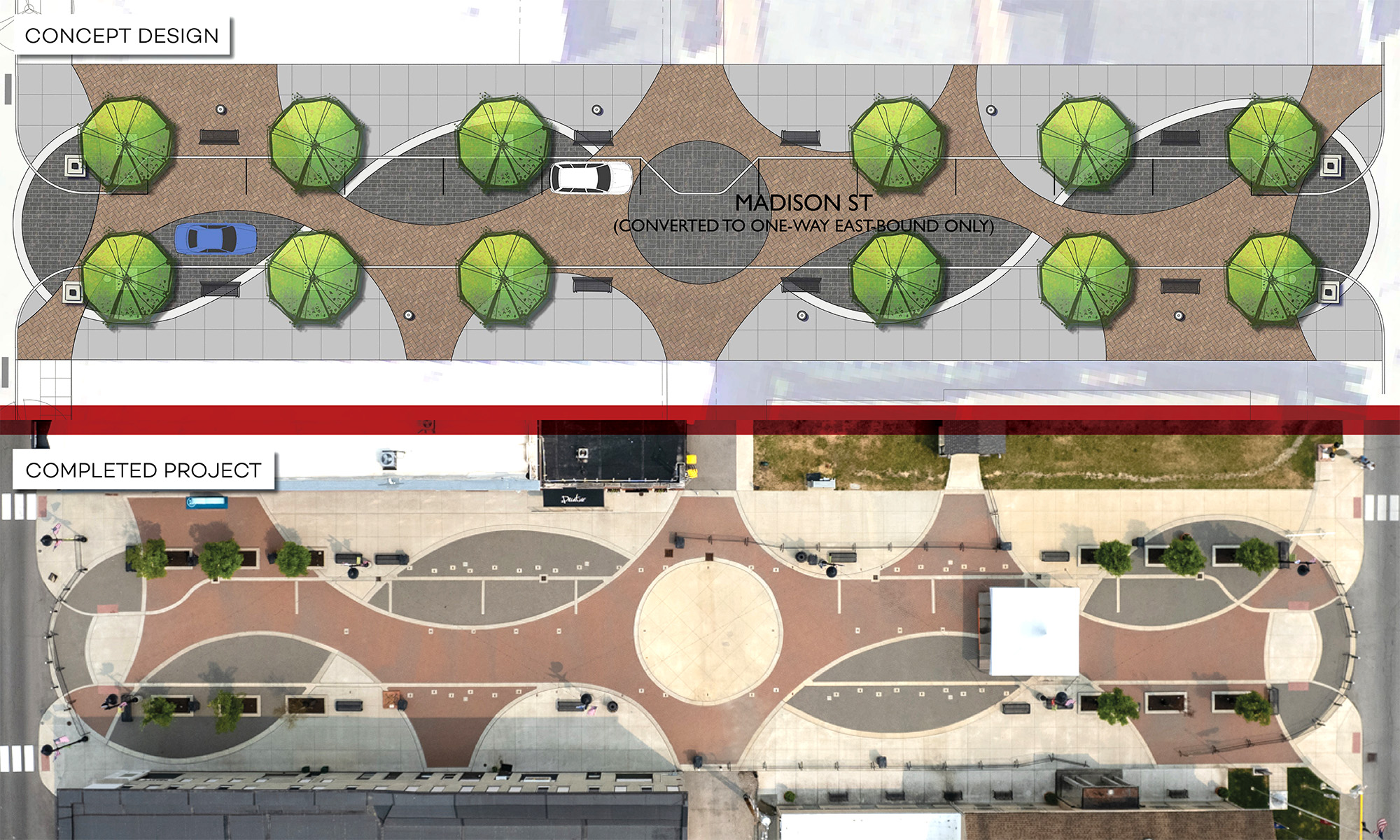
Imagine that a community wants to revitalize its downtown. Planners might help establish a vision for how streets, public spaces, businesses, transportation, and future development should work together.
Engineers, often working alongside other disciplines, then help translate that vision into detailed construction documents for sidewalks, utilities, streetscapes, drainage systems, lighting, roadway improvements, and other elements that make the vision possible.
The same partnership happens when designing a new park, expanding a school campus, improving a transportation network, or preparing land for future development.
Planning determines what should happen.
Engineering determines how it happens.
Communities face increasingly complex challenges, from aging infrastructure and changing transportation needs to environmental considerations and limited funding. Addressing those challenges often requires both long-term thinking and technical expertise.
Many projects involve multiple consultants, with planners developing one vision and engineers joining the project later. While that approach can work, having both disciplines under one roof and participating in both the planning and engineering process often creates a smoother, more coordinated process.
When planners and engineers collaborate from the beginning, they can:
Instead of passing a project from one team to another, everyone works toward the same goal from day one.
Whether it's creating a downtown master plan, designing a new athletic complex, improving utilities, or developing transportation infrastructure, planning and engineering each play a critical role.
At JPR, our planners, engineers, architects, landscape architects, environmentalists, and surveyors collaborate throughout the entire project. By combining long-range planning with technical engineering expertise, we help communities move confidently from vision to implementation—creating projects that are practical, buildable, and designed to serve people for generations.

SOUTH BEND
325 S. Lafayette Blvd.
South Bend, Indiana 46601
Phone: (574) 232-4388
FORT WAYNE
111 W Berry Street,
Fort Wayne, Indiana 46802
Phone: (260) 422-2522